
- Windows
- Home Improvement
Window Condensation in Tulsa: Inside, Outside, or Between the Panes?
Where the water sits tells you whether to relax, lower your humidity, or call someone.

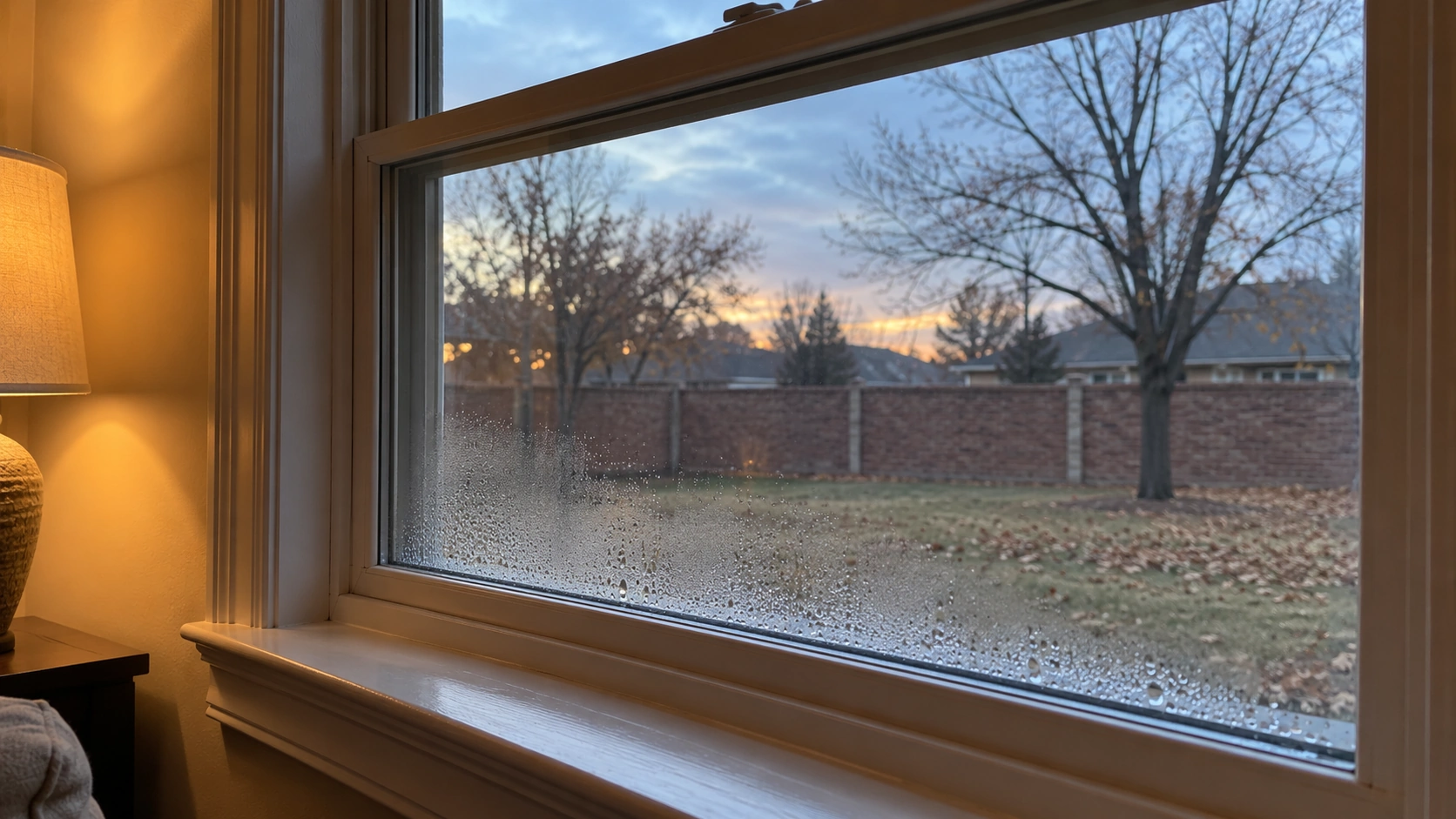
Where the moisture sits tells you what it means. Water on the outside of the glass is a sign your windows are working. Water on the inside surface is humidity meeting cold glass, and it is usually fixable without replacing anything. Fog or droplets trapped between the two panes is a failed seal, and that one really is the window. The National Weather Service puts Tulsa’s average first freeze around November 3, so the first cold mornings, and the first wet windows, are arriving right about now.
One of the most common questions we get this time of year is some version of “my windows are sweating, do I need new ones?” Across Tulsa, Broken Arrow, Owasso, Jenks, and the rest of Northeastern Oklahoma, the honest answer is usually no. Here is how to tell which of the three you are looking at.
Start With Where the Water Is
Before you do anything else, work out which surface is wet. Everything else follows from that.
| Where you see it | What it usually means | Do you need a pro? |
|---|---|---|
| Outside surface, early morning | Efficient glass doing its job | No |
| Inside surface, on cold mornings | Indoor humidity too high for the outdoor temperature | Usually not |
| Frost or ice on the inside glass | The same cause on a colder morning | Usually not, but fix the humidity |
| Between the two panes | Failed insulated glass seal | Yes |
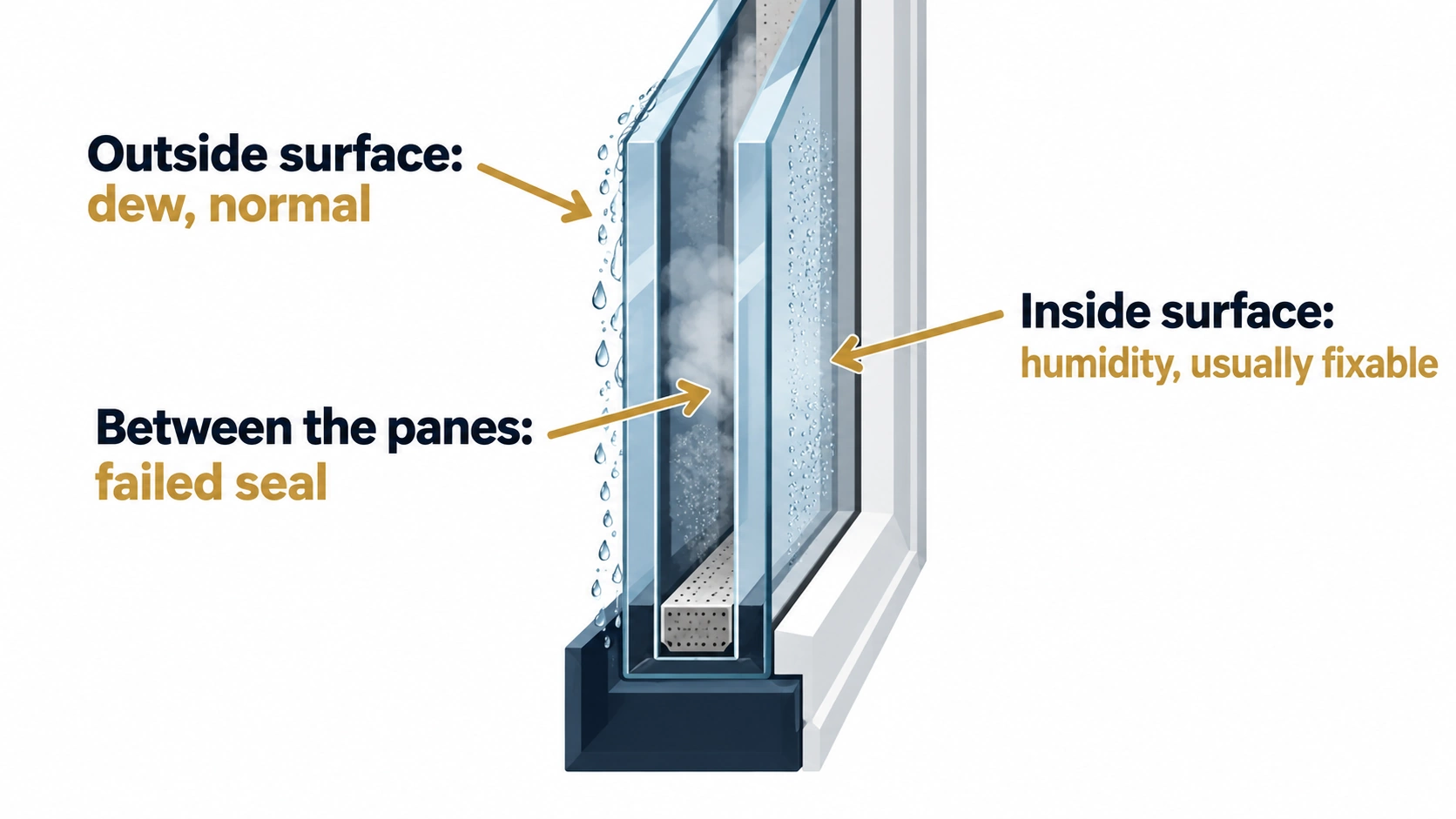
Water on the Outside: Good News
Dew on the outside of a window works exactly like dew on grass or frost on a parked car. On a clear, calm morning after a humid day, the outer pane can drop below the dew point and collect moisture. Oklahoma’s humid spring and fall mornings are exactly when it shows up.
Here is the part that surprises people: efficient windows do this more, not less. A leaky old window passes heat through the glass and keeps the outer surface warm enough to stay dry. A good double-pane with Low-E glass holds the heat inside, so the outside pane runs cold. If you see it, your glass is doing its job. It burns off once the sun hits the window, and there is nothing to fix.
Water on the Inside: Usually Humidity, Not the Window
Water on the room-side glass means the air in your house holds more moisture than that cold glass can tolerate. The colder it is outside, the colder the glass, and the less humidity the glass can handle before it starts collecting water. Window manufacturers publish charts for this, and the numbers below follow the common guidance:
| Outside temperature | Keep indoor humidity at or below |
|---|---|
| 40°F to 20°F | About 40% |
| 20°F to 10°F | About 35% |
| 10°F to 0°F | About 30% |
Most Tulsa winter mornings sit in the 20s and 30s, so the top row is the one that matters here. A hygrometer costs about $10, and most homeowners are surprised by what theirs says. Cold fronts in Oklahoma arrive with dry air, people respond by turning a humidifier up, and then the windows start to sweat. Showers without a bath fan, cooking without the range hood, laundry dried indoors, and a house full of plants add to it.
Fix the source in this order:
- Turn the humidifier down before you do anything else.
- Run the bath fan during showers and for 20 minutes after.
- Use the range hood when you cook.
- Open the blinds and curtains in the morning so air moves across the glass.
- Add a dehumidifier if the number stays high.
The honest part: do not replace windows to fix condensation caused by a humidifier. New windows will sweat less at the same humidity, because the inside glass stays warmer, but a house held at 50 percent in January will fog new glass too. The real damage is water pooling on the sill and the mold that follows, and that is a humidity problem.
The exception is old aluminum-frame and single-pane windows. Metal and thin glass run close to the outdoor temperature, so they sweat at humidity levels that are perfectly normal, and the drip rots sills over the years. For those, replacement is the real fix. Our guide to what old windows cost you on energy bills covers the frame types.
Frost on the inside glass is the same story on a colder morning. It means humidity is too high for the temperature, and it matters because the thaw soaks the sill and lifts the paint. Lower the humidity first.
If you are shopping for new windows, ask for the condensation resistance rating. It is an optional number between 0 and 100 on the NFRC label, higher is better, and manufacturers do not have to print it. It cannot predict whether your house will sweat, but it is a fair way to compare two windows.
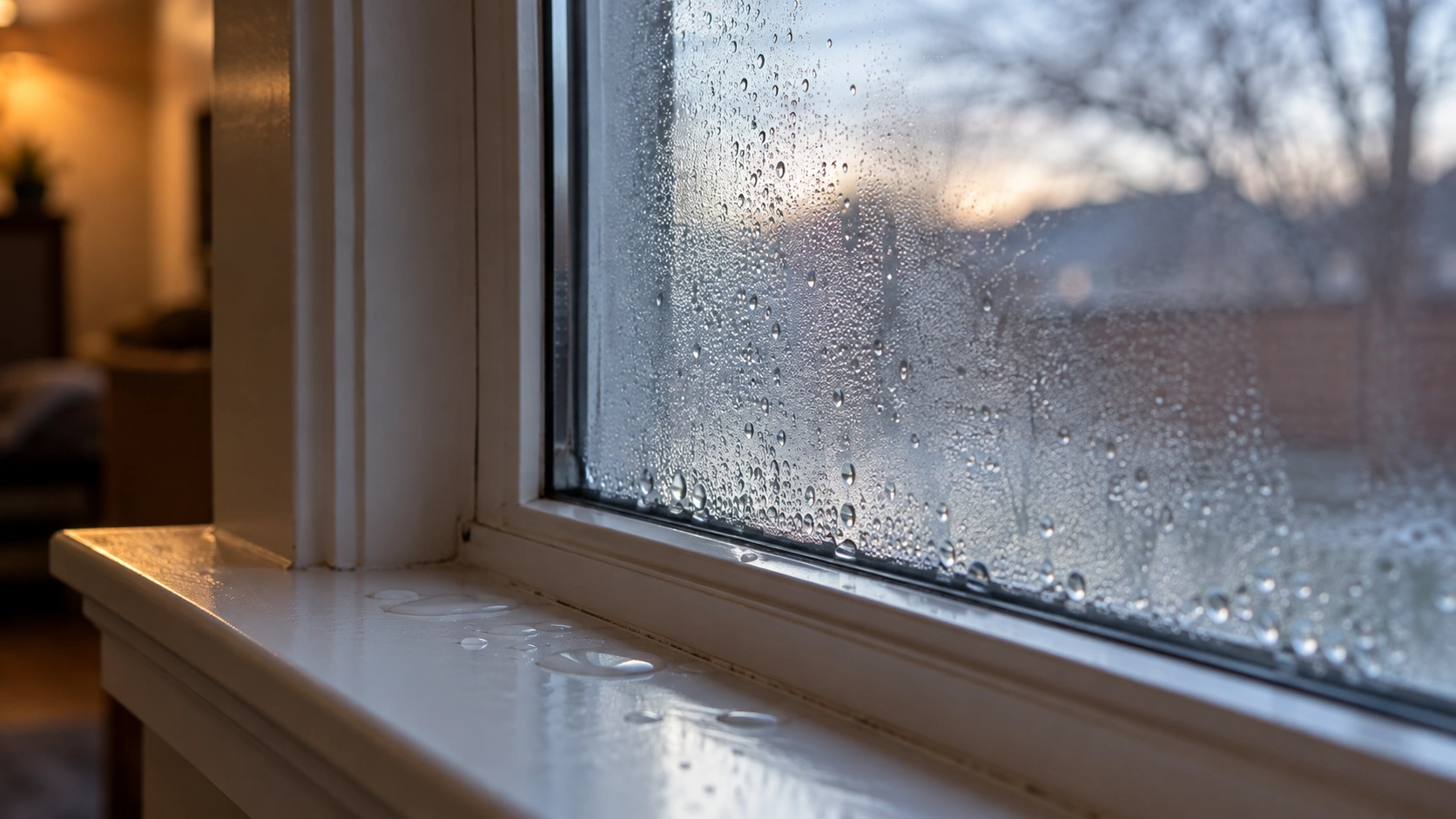
Water Between the Panes: This One Is the Window
Moisture, fog, or a milky haze between the two panes means the factory seal around the glass unit has failed. The insulating gas has leaked out and humid air has moved in. You cannot wipe it off, and no dehumidifier or hair dryer touches it, because the moisture is sealed inside the glass. Our checklist of signs a window is failing covers how to recognize it.
What matters here is the fix. If the frame and sash are sound, a glass-only replacement swaps the sealed unit and runs $500 to $750 per opening. A full replacement runs $700 to $1,100 per window installed. A “defogging” service that drills small holes and vents the unit clears the view, but it does not rebuild the sealed insulating layer.
After a hailstorm, check for new fog. A seal can fail even when the glass looks fine, and our hail damage guide walks through documenting it before you file a claim.
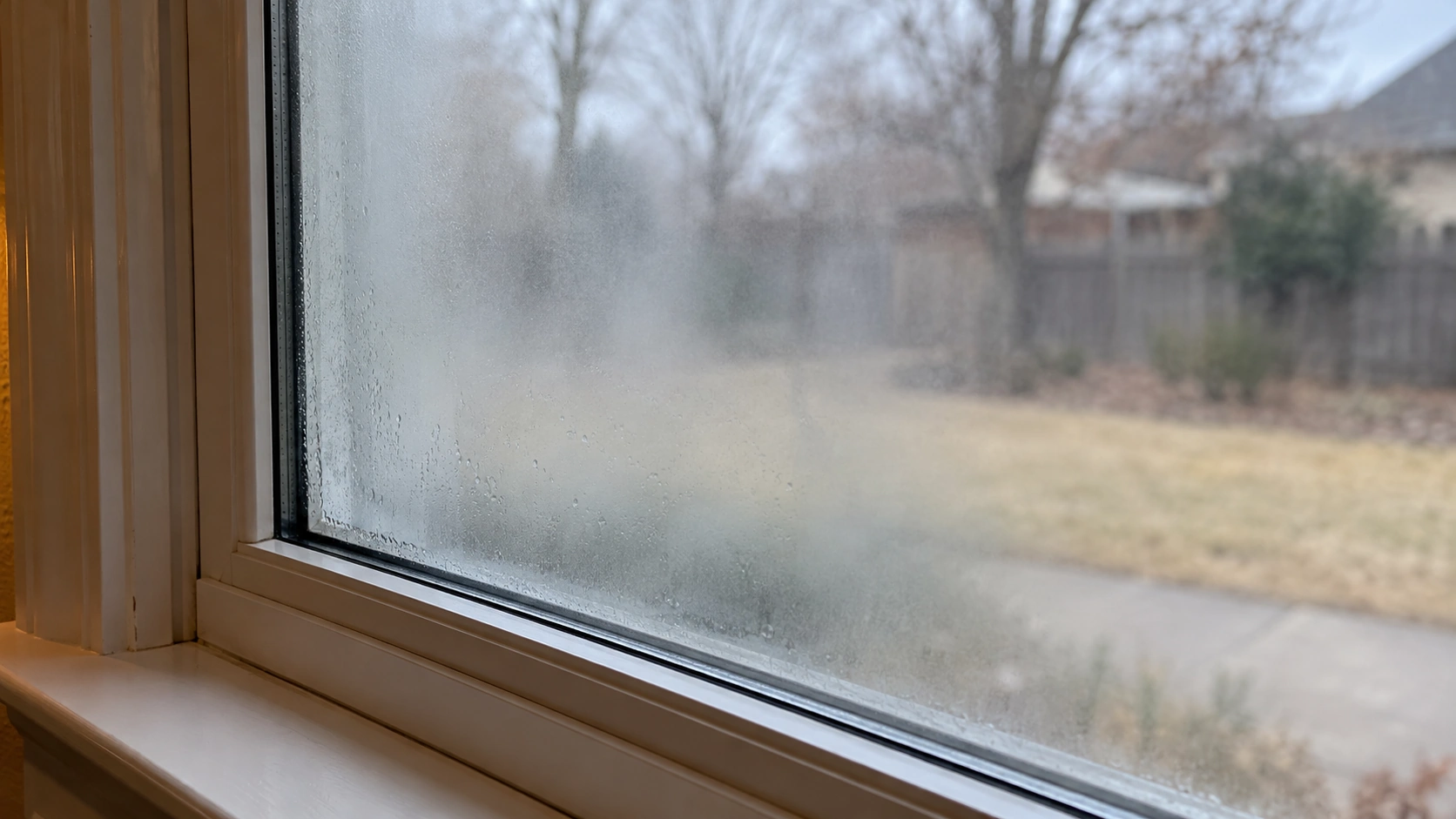
A Ten-Minute Check for This Week
- Put a hygrometer in the main living area and read it first thing in the morning.
- Walk the house and note which surface is wet on each window. Photograph anything between the panes.
- Wipe a wet inside surface with a dry cloth. If it comes off, it is humidity.
- Look at the outside of the glass at sunrise. Moisture there that fades by mid-morning is normal.
- Press a dry finger on each sill and the wood around the frame. Soft or spongy wood means water has been getting in for a while.
When Condensation Means Replace
Condensation alone rarely means replacement. These situations do:
- Fog between the panes on several windows. Units installed in the same era tend to fail around the same time.
- Wet or soft sills and frames, which means the moisture has been winning for years.
- Single-pane or aluminum-frame windows that sweat at normal humidity.
- A window that sweats at a healthy humidity while newer windows in the same room stay dry.
The math is worth doing before you decide. Three failed units on a 15-window house is 3 × $500 to $750, or $1,500 to $2,250 as glass-only replacements. Replacing all 15 is $10,500 to $16,500 at $700 to $1,100 each. Replacement work is backed by our 5-year workmanship warranty, and financing is available for qualifying projects if the answer turns out to be the whole house.
Not Sure Which One You Have?
If you cannot tell which surface is wet, or the answer is “all of them,” we will look at it and tell you straight. Sometimes the answer is a $10 hygrometer and a bath fan. Call Morgan Windows at (918) 400-2326 or request a free in-home estimate. We are a locally owned Oklahoma company serving Tulsa, Broken Arrow, Owasso, Jenks, Bixby, Sand Springs, Catoosa, and Claremore, and we would rather tell you a window is fine than sell you one you do not need. You can read more about our window replacement service any time.